

The fastest way to learn landing zones is to see one. The RC6² Red Carpet Drill marks a 6-by-6-foot target on the practice green, so every chip tells you exactly where it landed and what that landing did to the finish.
All it takes is eight tees, a ball marker and 20 minutes.
What you need
- 8 tees and 1 ball marker (or a set of ELZS RC6² Folds).
- 8 to 10 balls of the same model. ELZS charts were calibrated with three-piece balls, and mixing models changes the roll.
- The ELZS app or chartbook, and today's green speed from the pro shop.
- A hole on a quiet, flat part of the practice green, with a clean lie on short grass to start.
Set up the carpet
We'll use the example from the ELZS instructions: a 20-yard chip, slow green, pitching wedge. The landing zone is 10 paces.
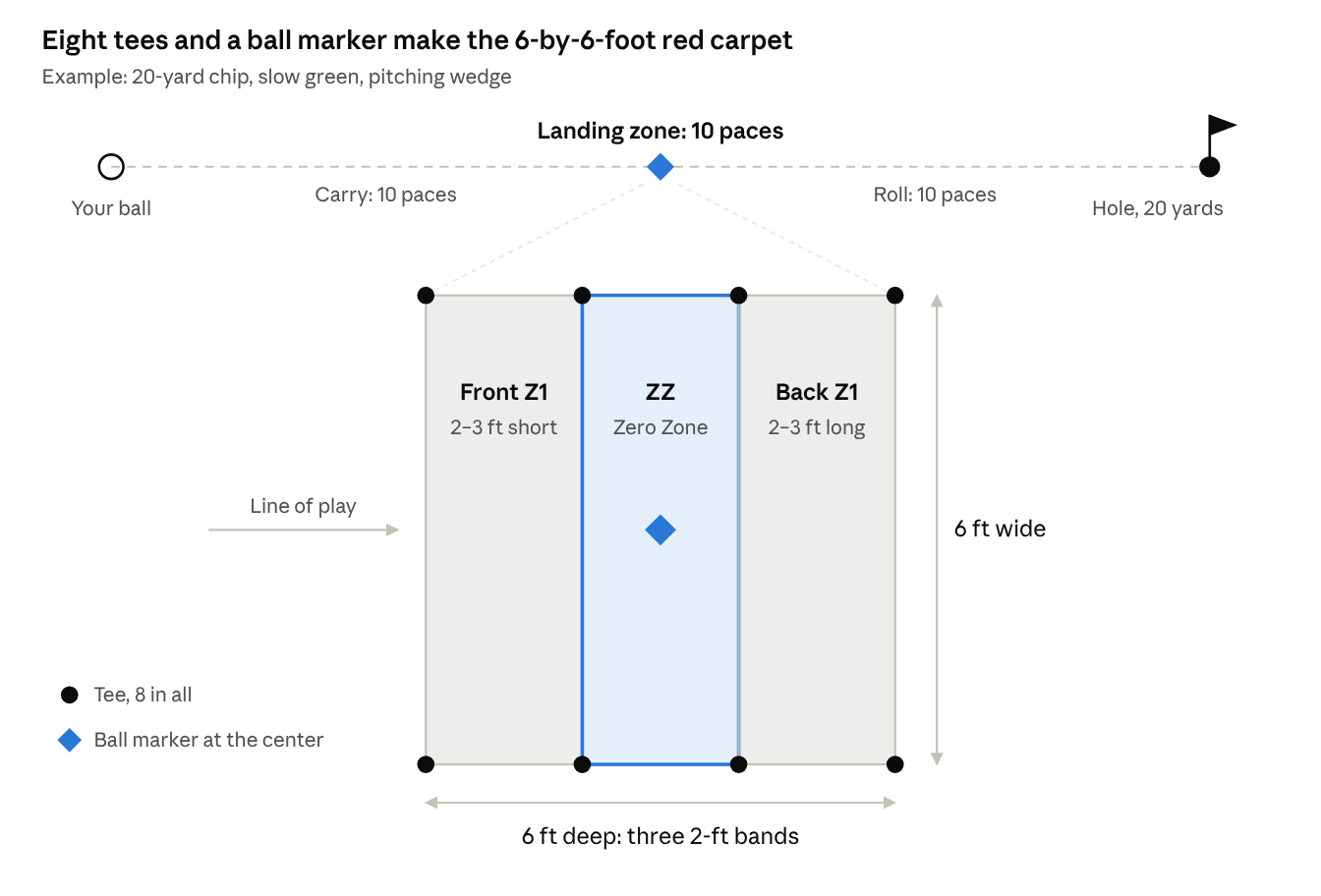
*The marker sits on the landing zone; the tees outline the carpet and split it into three 2-foot bands.*
1. Place the marker. Pace 10 steps from your ball toward the hole and set the ball marker down. That's the center of the Zero Zone. 2. Mark the corners. Put a tee 3 feet short of the marker and 3 feet past it, each 3 feet left and right of your line. That's the 6-by-6-foot carpet. 3. Mark the bands. Put a tee on each side, 1 foot short of the marker and 1 foot past it. You now have three 2-foot bands: front Z1, the Zero Zone (ZZ), and back Z1.
The ELZS video Setting up the RC6² walks through the same setup.
Run the drill
Hit 10 balls with the same club. Score each one by where it landed, not where it finished:
- ZZ: 2 points
- Either Z1 band: 1 point
- Off the carpet: 0 points
Then look at where each ball finished. A ZZ landing should leave you close to the hole, and a Z1 landing about 2 to 3 feet short or long.
When you score 15 or more out of 20 on two sets in a row, move up a level.
Five levels
1. One club, one distance. Groove the shot until the landing feels automatic. 2. One club, three distances. Move to 15, 20 and 25 yards, and reset the carpet from the chart each time. 3. A second club. Repeat levels 1 and 2 with your next club. The carpet moves half a pace closer for each step down in loft. 4. Random practice. Set three stations at different distances and hit one ball from each in turn. This is closer to how the course feels. 5. Up-and-down game. Chip, then putt out. Count how many of 10 you save.
What your misses are telling you
The carpet separates two problems that look the same from the clubhouse:
- The ball lands off the carpet. That's a contact or distance-control issue. Shorter landings usually mean the swing is decelerating; longer ones mean it's too big.
- The ball lands in ZZ but finishes well past or short. Your swing did its job. The green is faster or slower than the chart you used, so switch charts.
That second case is the one golfers usually blame on their stroke. With the carpet down, you can see it was the green.
Habits that make the drill work
- Look at the landing spot, not the hole, during your last look before the swing.
- Keep a relaxed grip and quiet hands. Tension adds speed you didn't plan.
- Picture the full shot first: the flight, the landing on the carpet, and the roll to the cup.
- Breathe before you hit. The ELZS instructions use box breathing: in for 4 seconds, hold for 4, out for 4, hold for 4.
With practice, aim to find your landing zone on the course in under 30 seconds.
Frequently asked questions
What is the best chipping drill?
A landing-spot drill. Mark a target where the ball should land, not around the hole, and score where each ball lands. The RC6² Red Carpet Drill uses eight tees and a ball marker to make a 6-by-6-foot target split into three bands.
How do I set up a landing zone on the practice green?
Look up your landing zone for your distance, club and green speed, pace it off and set a ball marker there. Put tees 3 feet in front of and behind the marker, 3 feet to each side, and two more on each side to mark 2-foot bands.
Why do my chips land in the right spot but finish far away?
Your contact was fine; the green is playing faster or slower than the chart you used. Move one chart faster if the ball runs past, or one chart slower if it stops short.
Set up your first carpet
Get your landing zone from the ELZS app or chartbook and pace it off on the practice green.
Download ELZS for iPhone · Get ELZS on Android
Short Game Notes
One useful email a month.
Keep learning
Where Should Your Chip Land? The Landing Zone, Explained
Where to land a chip shot: how carry and roll split, the three variables that set your landing zone, and the RC6² red-carpet target from ELZS.
Coaching the Short Game With Landing Zones: A 4-Week Program for Coaches and Teams
Short-game drills for golf teams: a baseline test, a 4-week landing-zone program, station setups for a full squad and games that keep players scoring.
Green Speed Changes Everything: What the Stimpmeter Means for Your Chips
How green speed changes where your chips should land: what a Stimpmeter reading means, the four ELZS green-speed charts, and how to find today's speed.
Uphill, Downhill, Wet and Grainy: Adjusting Your Landing Zone for Real Greens
How to chip uphill and downhill, into grain, on wet or firm greens and from rough: how each condition changes the speed and where your chip should land.