

The ELZS charts give you the landing zone for a flat, dry green and a clean lie. Real greens tilt, hold water and grow in one direction. The good news: almost every adjustment comes down to one question. Will this condition make the ball roll more or less than the chart expects?
If it rolls more, land it shorter. If it rolls less, land it farther.
Slope changes the speed the green plays at
A ball rolling uphill slows down faster, so an uphill chip plays like a slower green. Downhill, it plays like a faster one. The surprise is how lopsided that effect is.
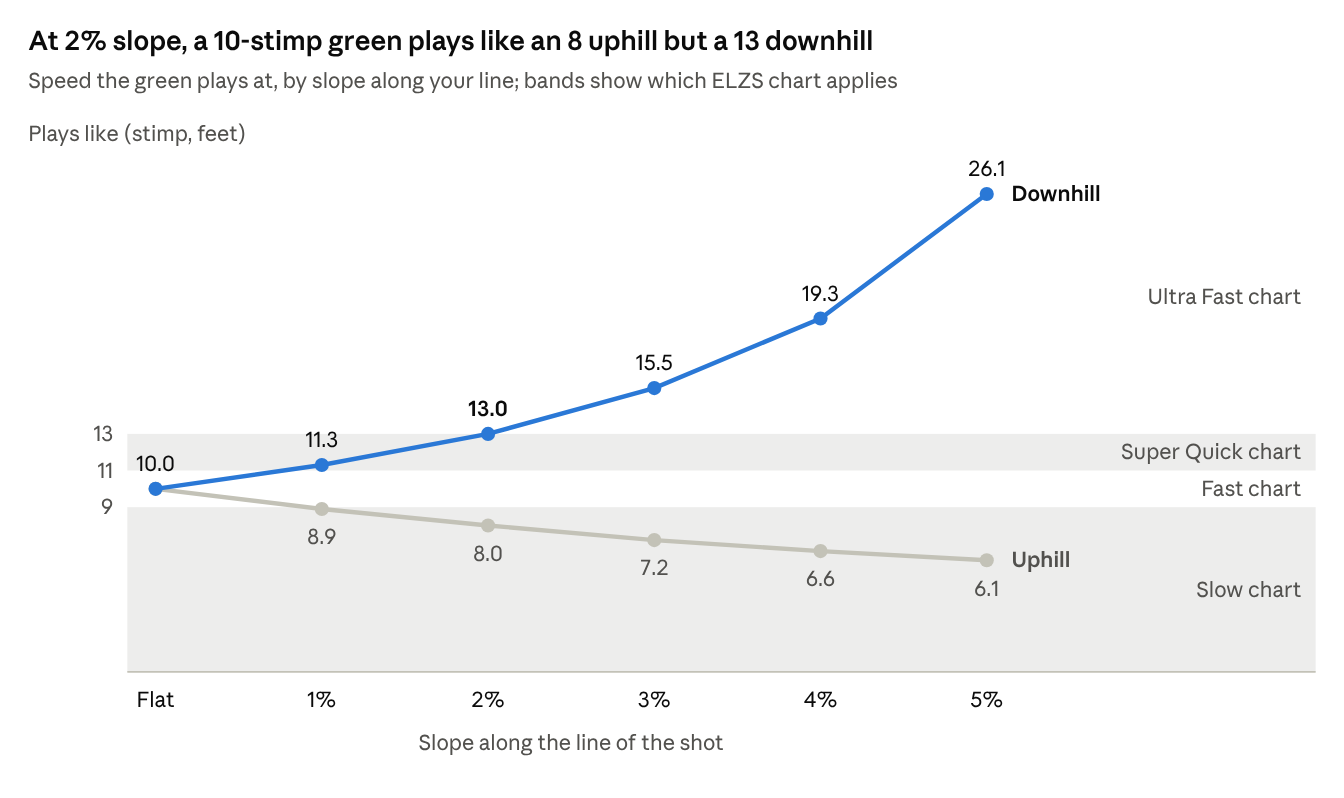
*Source: ELZS Chartbook slope reference, Stimp 10 column, slopes of 1 to 5%.*
On a green that stimps at 10, a 2% uphill slope makes it play like an 8. The same 2% downhill makes it play like a 13. At 4%, it's about 6.6 going up and about 19 going down.
Those figures come from the slope reference in the ELZS Chartbook, and they hold up. Turf scientists measure speed on sloped greens with the Brede equation, which combines an uphill and a downhill roll into the green's true speed (Asian Turfgrass Center). Run each uphill and downhill pair in the reference through it, and every one comes back to roughly 10.
Turning slope into a chart choice
The practical move is to use the chart that matches the speed the green will play at. For a Fast (blue) green that stimps around 10:
- 1% uphill: plays close to 9, on the line between Fast and Slow. Land it slightly farther.
- 2% uphill: plays like 8. Use the Slow chart.
- 1% downhill: plays like 11.3. Use the Super Quick chart.
- 2% downhill: plays like 13. Use the Ultra Fast chart.
- Steeper downhill: it's beyond the charts. Use your most lofted club, land it as close to you as the green allows, and accept a longer putt.
To picture the numbers, a 1% slope drops about 3.6 inches over 10 yards. If you can clearly see the tilt, it's usually more than that.
Side slope
Slope across your line doesn't change the speed much, it changes the line. Read the break as you would for a putt of the same length as the roll, and move your landing zone up the slope so the ball curves down to the hole.
Grain
Grain is the direction the grass blades lie, and it's strongest on Bermuda and other warm-season grasses. Landing into the grain checks the ball. Landing down-grain lets it run.
A common cue: grass that looks shiny and light is usually growing away from you, and grass that looks dark and dull is growing toward you. Expect more roll on the shiny side.
Wet and firm greens
- Wet or soft greens: the ball may skid on landing and then grab. Expect less roll than the chart; land it a little farther or move one chart slower.
- Firm, dry greens: the first bounce kicks forward and the ball releases. Land it shorter, or move one chart faster.
Conditions can change during a round, so check how the first few chips on the course react.
Wind
Wind matters more on high pitches than on low chips. Into the wind, the ball flies shorter, lands more steeply and stops sooner. Downwind, it flies farther and releases more.
Rough and bad lies
Grass between the ball and the clubface reduces spin and makes contact less predictable. The ELZS instructions say to think of the landing zone as twice its normal size from a bad lie, and to make getting the ball onto the green the priority. Expect it to roll out more than it would from the fringe.
Tiers and elevated greens
When you can, land the ball on the same tier as the hole. If you have to land below a ridge and run up it, treat the shot as uphill. If you land above and run down, treat it as downhill, and remember that downhill is the bigger adjustment.
Frequently asked questions
How do you chip downhill?
Treat the green as faster than its stimp reading and land the ball shorter. On a 10-stimp green, a 2% downhill slope plays like a 13, so use a faster chart. On steep downhill chips, use your most lofted club and accept a longer putt.
Does slope affect uphill and downhill chips equally?
No. Downhill slope speeds a green up much more than the same uphill slope slows it down. On a 10-stimp green at 4%, uphill plays like about 6.6 while downhill plays like about 19.
How do wet greens change a chip shot?
Wet or soft greens usually stop the ball sooner after an initial skid. Land the ball a little farther than the chart says, or move one chart slower. Firm, dry greens do the opposite.
Keep the reference in your bag
The slope reference is printed in the ELZS Chartbook. Keep it in your bag for practice and preparation, and look up your flat-green zone in the ELZS app.
Download ELZS for iPhone · Get ELZS on Android · Green speed explained
Short Game Notes
One useful email a month.
Keep learning
Where Should Your Chip Land? The Landing Zone, Explained
Where to land a chip shot: how carry and roll split, the three variables that set your landing zone, and the RC6² red-carpet target from ELZS.
Coaching the Short Game With Landing Zones: A 4-Week Program for Coaches and Teams
Short-game drills for golf teams: a baseline test, a 4-week landing-zone program, station setups for a full squad and games that keep players scoring.
Green Speed Changes Everything: What the Stimpmeter Means for Your Chips
How green speed changes where your chips should land: what a Stimpmeter reading means, the four ELZS green-speed charts, and how to find today's speed.
The Red Carpet Drill: How to Practice Landing Zones With RC6²
A chipping practice drill built on landing zones: set up the 6-by-6-foot RC6² carpet with eight tees, score your landings and work through five levels.