

A chip doesn't score on its own. It sets up the putt that follows, and the length of that putt decides whether you save the stroke. Tour players make almost every 3-footer and fewer than half of their 9-footers, so a chip that finishes 6 feet closer is worth far more than it looks.
Proximity is the whole game
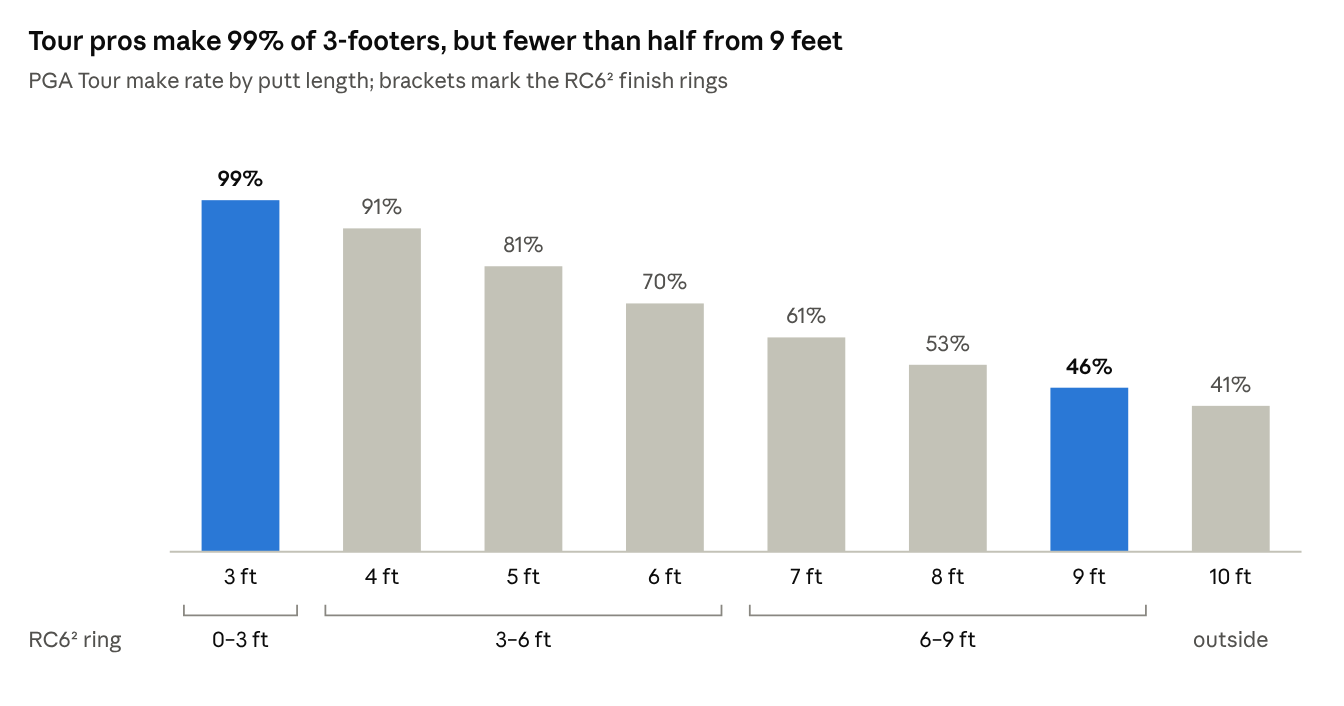
*Source: PGA Tour averages compiled by GOLF.com (2019), putts of 3 to 10 feet. Brackets mark the RC6² finish rings.*
Each foot past 3 costs a tour player about 9 percentage points of make rate until about 8 feet (GOLF.com).
Amateurs face a steeper curve. Mark Broadie's research, the basis of strokes-gained statistics, found that golfers who shoot around 90 make about 84% of 3-foot putts and about two-thirds of putts inside 5 feet (GolfWRX, citing Every Shot Counts). Every foot your chip leaves you costs more than it costs a pro.
Where the strokes go
Shot Scope's 2026 performance report, drawn from more than 74 million shots in over 870,000 rounds, found that most golfers need three or more shots to finish from 50 yards (Golf Today). It also found that up-and-down success falls quickly as the starting distance grows.
The same report shows where the first shot goes wrong. Coming up short with a wedge accounts for roughly 40% of misses, at every handicap level (The First Call). The carry was wrong, so the roll never had a chance.
A simple illustration
Count your chips and pitches in your next round. Say it's eight. Now imagine every one finishing 3 feet from the hole instead of 9.
At tour make rates, that's the difference between holing about 46% of the follow-up putts and about 99%. Across eight chips, that's roughly four strokes. Your own numbers will differ, but the direction won't: the closer the chip, the fewer the putts.
The RC6² rings
ELZS builds this math into its target. Land the ball on the 6-by-6-foot RC6² red carpet and you're aiming for three finish rings around the hole:
- 0 to 3 feet: the first choice. Close to automatic.
- 3 to 6 feet: still a strong save chance.
- 6 to 9 feet: an honest putt for par.
Landing in the middle band (ZZ) is how you get to the inner ring. The front and back bands (Z1) typically leave you 2 to 3 feet short or long, still inside the second ring.
Measure your own short game
You can't improve what you don't count. For one round, write down three things for every shot from within 50 yards:
| What to record | Example | | --- | --- | | Distance to the hole and club | 18 yd, gap wedge | | Where it landed versus your landing zone | Front Z1 | | How far it finished from the hole | 4 ft |
After one round you'll know your average finish distance and your up-and-down rate. After five rounds you'll know whether your misses are mostly short or long, which tells you what to practice.
Spend your practice where the strokes are
The ELZS method recommends spending 50 to 60% of practice time on shots inside 100 yards and on short putts. For most golfers, that's far more than the short game gets today.
If that feels like a big shift, start smaller. Give your next practice session 20 minutes on one chip shot with a known landing zone, and finish with 20 putts from 3 to 6 feet. The Red Carpet Drill gives that time a structure.
Frequently asked questions
What percentage of 3-foot putts do pros make?
PGA Tour players make about 99% of 3-foot putts, about 70% from 6 feet and about 46% from 9 feet, based on tour averages compiled by GOLF.com. Golfers who shoot around 90 make about 84% from 3 feet, according to Mark Broadie's research.
How many strokes can a better short game save?
It depends on how often you chip and how close you finish. As an illustration, eight chips finishing 3 feet away instead of 9 is worth roughly four strokes at tour make rates. Track one round to find your own number.
How should I track my short game?
For every shot inside 50 yards, record the distance and club, where it landed compared with your landing zone, and how far it finished from the hole. After five rounds, your misses will show a pattern worth practicing.
Turn the math into a plan
Track one round, then use the ELZS app to find the landing zones for the shots you missed.
Download ELZS for iPhone · Get ELZS on Android · Where should your chip land?
Short Game Notes
One useful email a month.
Keep learning
Where Should Your Chip Land? The Landing Zone, Explained
Where to land a chip shot: how carry and roll split, the three variables that set your landing zone, and the RC6² red-carpet target from ELZS.
Coaching the Short Game With Landing Zones: A 4-Week Program for Coaches and Teams
Short-game drills for golf teams: a baseline test, a 4-week landing-zone program, station setups for a full squad and games that keep players scoring.
Green Speed Changes Everything: What the Stimpmeter Means for Your Chips
How green speed changes where your chips should land: what a Stimpmeter reading means, the four ELZS green-speed charts, and how to find today's speed.
The Red Carpet Drill: How to Practice Landing Zones With RC6²
A chipping practice drill built on landing zones: set up the 6-by-6-foot RC6² carpet with eight tees, score your landings and work through five levels.