

Most amateurs reach for a sand or lob wedge on every shot around the green. Data from shot-tracking company Shot Scope suggests that habit costs them: 15-handicap golfers were 8% more likely to succeed with a lower-lofted club than with a lofted wedge (MyGolfSpy, partner content with Shot Scope). Yet those golfers chose a gap, sand or lob wedge 52% of the time, and an 8-iron, 9-iron or pitching wedge only 20%.
The club you choose sets how far the ball flies and how far it rolls. Pick it on purpose.
Each club changes the split, not the total
The hole doesn't move when you change clubs. What moves is how much of the trip happens in the air.
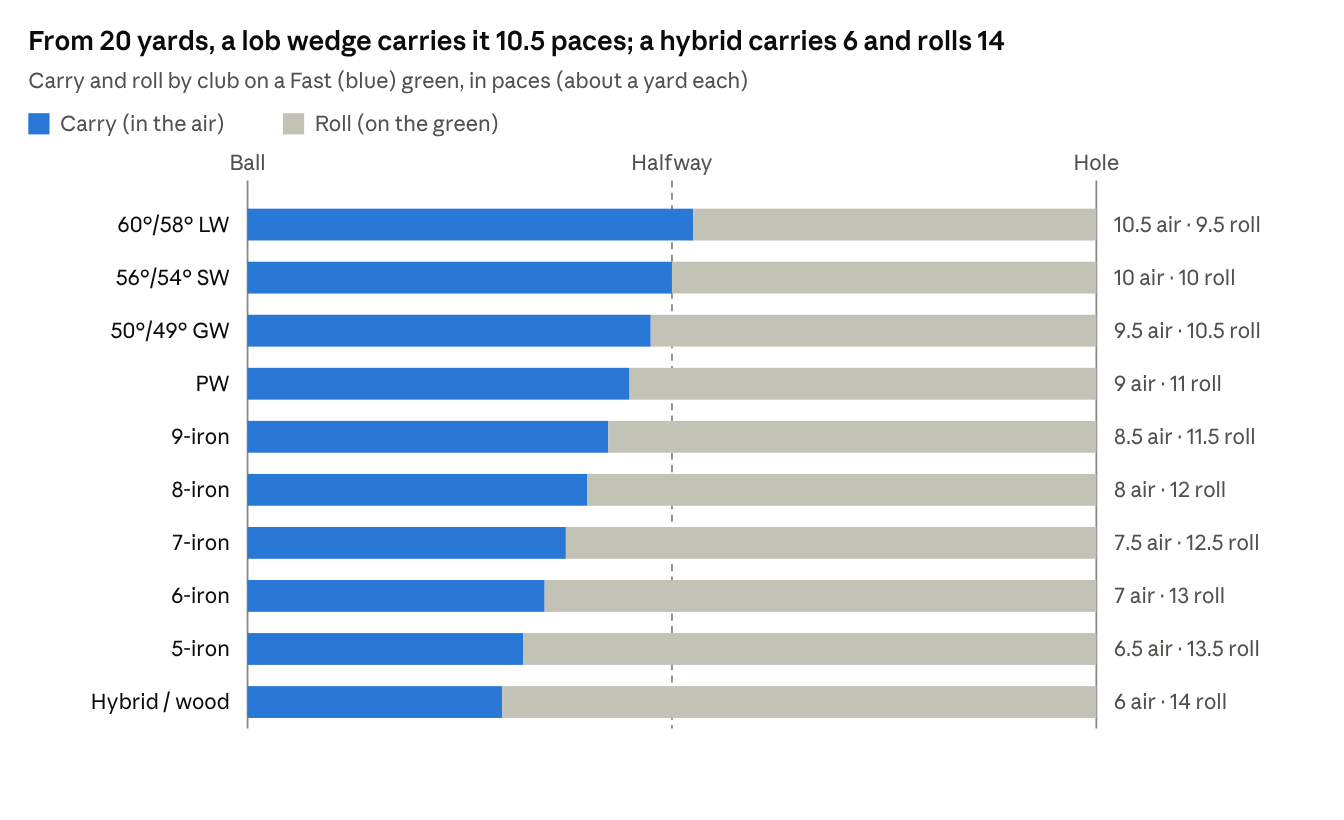
*Source: ELZS Fast (blue) chart, 20-yard chip, 10 clubs.*
The total never changes; the share in the air falls from just over half with a lob wedge to under a third with a hybrid.
The ELZS charts cover ten clubs, from the 60°/58° lob wedge down to a hybrid or fairway wood. One pattern holds across every chart and every distance: each step down in loft lands the ball half a pace shorter. Go from a sand wedge to a gap wedge and you land it half a pace sooner; go to a 7-iron and you land it two and a half paces sooner.
A second pattern helps you estimate between rows: every extra yard to the hole adds half a pace of carry, whatever the club.
Why a lower-lofted club is often the safer shot
A lower-lofted chip needs a smaller swing to cover the same distance. A smaller swing at lower speed is easier to repeat, and a slight mishit costs less distance.
It also spends more of the trip on the ground. Once the ball is rolling, it behaves like a putt, and most golfers read and judge putts better than they judge flight.
When to reach for the lofted wedge anyway
A lower club needs green to roll on. Go higher when:
- You're short-sided. The hole is close to your edge of the green, so a low club's landing zone would fall in the fringe or rough.
- Something is in the way. A bunker, a ridge or deep rough between you and the green has to be carried.
- The green is ultra fast or runs away from you. Low clubs may have no usable landing zone at all.
The "midpoint" club on each chart
Each ELZS chart has one club that lands the ball exactly halfway to the hole, at every distance:
| ELZS chart | Club that lands it halfway | | --- | --- | | Slow | Pitching wedge | | Fast | 56°/54° sand wedge | | Super Quick | 60°/58° lob wedge | | Ultra Fast | None (every club lands short of halfway) |
It's a useful anchor. On a slow green with a pitching wedge, half in the air and half on the ground is the whole calculation.
How to choose, in three steps
1. Find the front edge of the green on your line, and pace it off from your ball. 2. Look up your landing zone for a club you trust. You want it 2 to 3 paces past the edge of the green. 3. Adjust one club at a time. If the zone lands short of the green, go up in loft. If it lands much deeper than 3 paces onto the green, go down in loft and let it roll.
Start with two clubs, not ten
You don't need to master ten clubs. Pick two, such as a sand wedge for short, tight shots and a 9-iron or pitching wedge for longer runs. Learn their landing zones on your home course's green speed first.
Once those two feel automatic, add a third. The half-pace rule means each new club is a small, predictable step from one you already know.
Frequently asked questions
What is the best club to chip with?
The one that lands the ball 2 to 3 paces onto the green and rolls the rest of the way. That's often a 9-iron or pitching wedge rather than a lob wedge. Shot Scope data shows 15-handicappers succeed more often with lower-lofted clubs.
Should I chip with a 9-iron or a wedge?
Use the 9-iron when you have plenty of green between the fringe and the hole, because it carries less and rolls more. Use a wedge when you're short-sided or need to carry a bunker, rough or a ridge.
How much does changing clubs change the landing spot?
On the ELZS charts, each step down in loft lands the ball half a pace shorter, at every distance and green speed. Going from a sand wedge to a 7-iron moves the landing spot two and a half paces closer to you.
Compare your clubs in ELZS
Open the ELZS app, enter one distance, and compare the landing zones for your two favorite clubs.
Download ELZS for iPhone · Get ELZS on Android · How green speed changes the answer
Short Game Notes
One useful email a month.
Keep learning
Where Should Your Chip Land? The Landing Zone, Explained
Where to land a chip shot: how carry and roll split, the three variables that set your landing zone, and the RC6² red-carpet target from ELZS.
Coaching the Short Game With Landing Zones: A 4-Week Program for Coaches and Teams
Short-game drills for golf teams: a baseline test, a 4-week landing-zone program, station setups for a full squad and games that keep players scoring.
Green Speed Changes Everything: What the Stimpmeter Means for Your Chips
How green speed changes where your chips should land: what a Stimpmeter reading means, the four ELZS green-speed charts, and how to find today's speed.
The Red Carpet Drill: How to Practice Landing Zones With RC6²
A chipping practice drill built on landing zones: set up the 6-by-6-foot RC6² carpet with eight tees, score your landings and work through five levels.